A dental crown, sometimes called a dental cap, is a fixed prosthetic restoration that encases the entire visible portion of a tooth above the gum line. It is cemented permanently onto a prepared tooth structure, providing both protection and restoration of normal form, function, and appearance.
International Dental Hub offers dental crowns in Lahore when a tooth has been significantly compromised by decay, fracture, root canal therapy, or severe wear. The crown does not merely patch the surface. Instead, it redistributes occlusal forces evenly across the tooth, prevents further structural breakdown, and restores the patient's bite to a physiologically sound position.
We use precise impression techniques and work with accredited dental laboratories to design crowns that replicate the natural morphology of the tooth being restored. Each crown is individually crafted to ensure correct interdigitation with opposing teeth and harmony with adjacent dentition.
International Dental Hub offers the best dental crowns in Lahore. It helps you in the following ways.
Full structural protection. The crown encases the entire tooth, shielding weakened enamel and dentin from further fracture or bacterial invasion.
Restored chewing function. Patients regain full occlusal function, allowing comfortable chewing on both sides of the arch without pain or sensitivity.
Natural aesthetics. Zirconia and porcelain crowns are shade-matched to adjacent teeth under standardised lighting conditions, producing a restoration that is virtually indistinguishable from natural enamel.
Long-term durability. With proper oral hygiene, a well-fitted crown can provide reliable service for 10 to 15 years or more, depending on the material selected and any parafunctional habits.
Improved confidence. Restoration of a damaged or discoloured tooth positively affects a patient's self-image and willingness to smile in professional and social settings.
Post-root canal reinforcement. Teeth that have undergone root canal therapy are significantly more brittle. Placing a crown over such teeth is the accepted standard of care to prevent cusp fracture and prolong the life of the tooth.
Crown placement at International Dental Hub follows a structured clinical protocol across two primary appointments. Just like other dental treatments, including dental implants and smile makeovers, we provide expert dental care. Below is the complete process from the moment you book to the final cementation of your restoration.
Step 1: Appointment booking and initial consultation. You contact IDH to schedule your appointment. At the first visit, our clinician takes a comprehensive history, reviews your chief complaint, and performs a clinical and radiographic examination. Digital periapical or panoramic radiographs are taken to assess bone levels, root morphology, and periapical status. We confirm whether crown placement is the appropriate treatment or whether prior endodontic or periodontal intervention is required.
Step 2: Treatment planning and material selection. Based on the examination findings, the tooth's position in the arch, occlusal load, and your aesthetic goals, our dentist recommends the most suitable crown material. We discuss zirconia, E-max, porcelain-fused-to-metal, and other options with you, explaining the clinical rationale for each. Shade selection is performed under standardised lighting conditions using a VITA shade guide.
Step 3: Tooth preparation under local anaesthesia. On the day of preparation, the tooth is fully anaesthetised. The clinician reduces the tooth uniformly, typically 1.0 to 2.0 mm circumferentially and 1.5 to 2.0 mm occlusally, to create the necessary space for the crown material. A supragingival or slightly subgingival finish line is prepared depending on the crown type. The preparation is carried out with water-cooled diamond burs to prevent pulpal thermal damage.
Step 4: Impression and provisional crown placement. A precise impression is taken using polyvinyl siloxane (PVS) material, capturing the preparation and the opposing arch. Bite registration is recorded to communicate correct occlusal relationships to the laboratory. A provisional crown is then fabricated and cemented with temporary cement to protect the prepared tooth, maintain the interproximal space, and preserve aesthetics during the laboratory fabrication period.
Step 5; Laboratory fabrication. The impression is sent to our accredited dental laboratory, where skilled technicians mill or press the crown using the selected material. The shade, contour, and marginal fit are verified against the prescription. Fabrication typically takes 5 to 7 working days. You wear the provisional crown comfortably throughout this period.
Step 6: Try-in, adjustment, and final cementation. At your second appointment, the provisional crown is removed and the tooth is cleaned. The permanent crown is trialled on the preparation. The clinician checks the marginal fit, proximal contacts, occlusion, and aesthetics. Any necessary adjustments are made chairside. Once the fit is confirmed and the patient is satisfied, the crown is cemented with a permanent luting agent, either resin-modified glass ionomer or dual-cure resin cement, depending on the crown material. Post-cementation occlusion is verified with articulating paper.
Step 7: Post-operative instructions and follow-up. Written post-operative instructions are provided. Patients are advised to avoid hard or sticky foods for 24 hours, maintain regular brushing and flossing, and use floss threaders at the crown margins. A follow-up appointment is scheduled at 4 to 6 weeks to review the periodontal response and occlusal comfort.
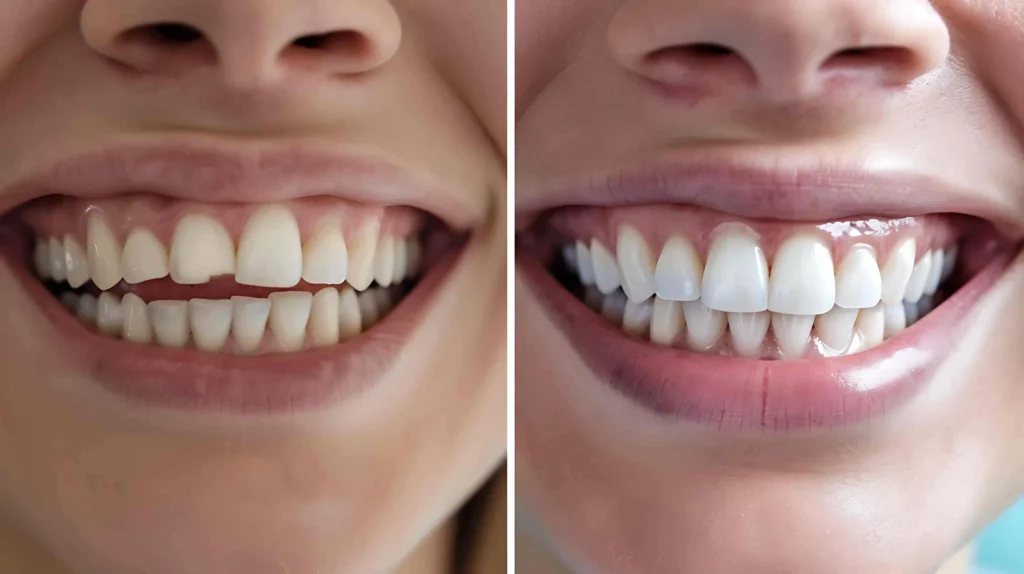
The images in this section illustrate representative clinical outcomes achievable with our crown restorations.
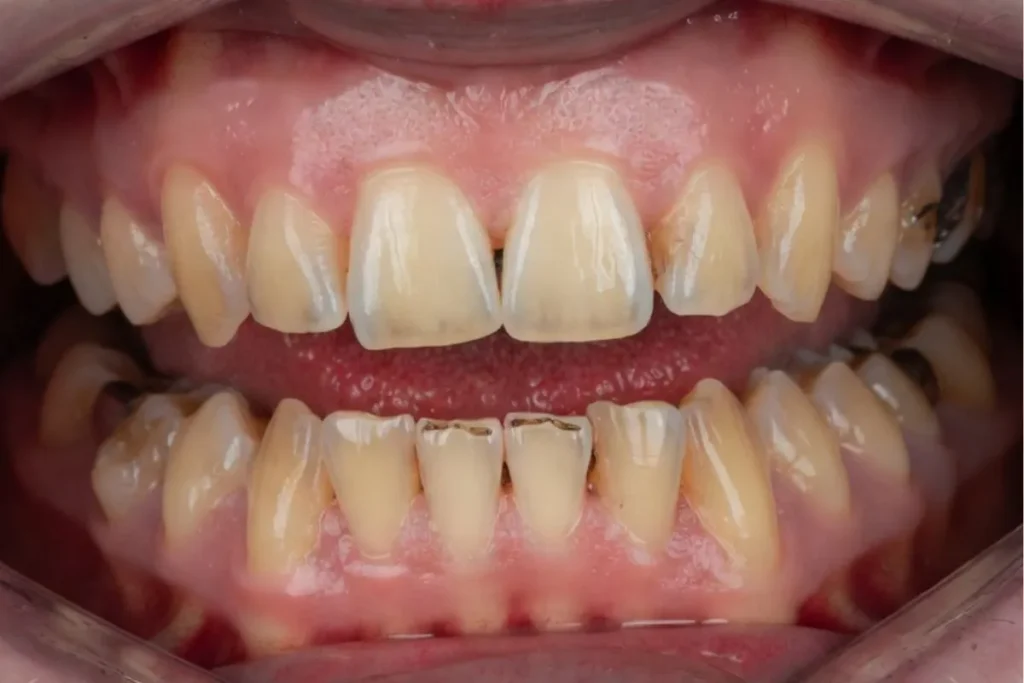
Before treatment: Significant coronal breakdown, discolouration, and sensitivity on biting. The tooth presents with decay, fracture, or post-endodontic structural weakness.
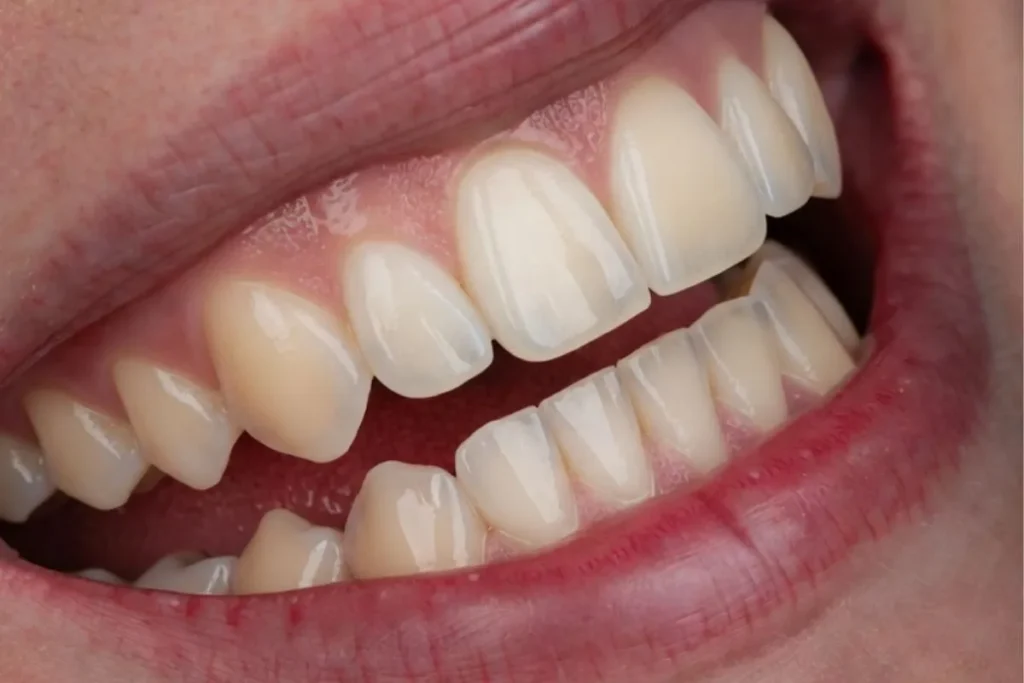
After crown placement: Complete restoration of tooth anatomy, uniform shade match to adjacent teeth, and no occlusal discrepancy.
Full-Contour Zirconia (Most recommended). Monolithic zirconia crowns are milled from a single block of high-strength zirconium dioxide. They offer exceptional fracture resistance with acceptable translucency, making them the material of choice for posterior teeth. Zirconia is metal-free, biocompatible, and requires relatively conservative tooth preparation. Flexural strength ranges from 900 to 1,200 megapascals MPa)
E-max (Lithium Disilicate) (Preferred for anterior teeth). Pressed ceramic crowns offer superior translucency and light transmission that closely mimics natural enamel. E-max crowns are the preferred aesthetic choice for front teeth and premolars. Flexural strength is approximately 400 MPa. Conservative preparation is possible with this material.
Porcelain-Fused-to-Metal (PFM) A metal substructure veneered with tooth-coloured porcelain. PFM crowns have a proven long-term track record in restorative dentistry and offer adequate strength at a lower cost. The metal margin may become visible with gum recession over time, which is a consideration in aesthetic zones.
Full Metal (Gold or Base Metal Alloy): Recommended for patients with heavy bruxism or limited inter-occlusal space. Full cast metal crowns require the least tooth reduction, cause minimal wear to the opposing dentition, and are extremely durable. Their use is limited to posterior teeth where aesthetics are not a priority.
Layered Zirconia ( High translucency option): A zirconia framework veneered with feldspathic porcelain for enhanced natural appearance. Suitable for anterior cases where full monolithic zirconia does not provide the required level of translucency. Fabrication is more laboratory-intensive, and the porcelain layer is susceptible to chipping under heavy occlusal forces.
Your crown treatment at IDH will be performed by a qualified member of our clinical dental team. Each dentist brings a rigorous academic background and hands-on restorative experience.
As a trusted dental clinic in Lahore, International Dental Hub provides high-quality dental crowns. Here is why patients in Lahore trust us:
High-quality dental crowns can last 10 to 15 years or longer with proper care and regular dental visits.
Yes. Modern crowns are designed to closely match the color, shape, and appearance of natural teeth.
Porcelain and zirconia crowns are highly resistant to staining compared to natural teeth.
No. A root canal is only necessary if the tooth pulp is infected or severely damaged.
Yes. Once the permanent crown is placed, patients can comfortably eat and chew normally.
03134567153
internationaldentalhubb@gmail.com
International Dental Hub, 194A C, Sector C Gulmahar Block Sector C Bahria Town, Lahore, 54000, Pakistan
Copyright © 2026 All Right Reserved IDH, Developed by Search Engine Brain