
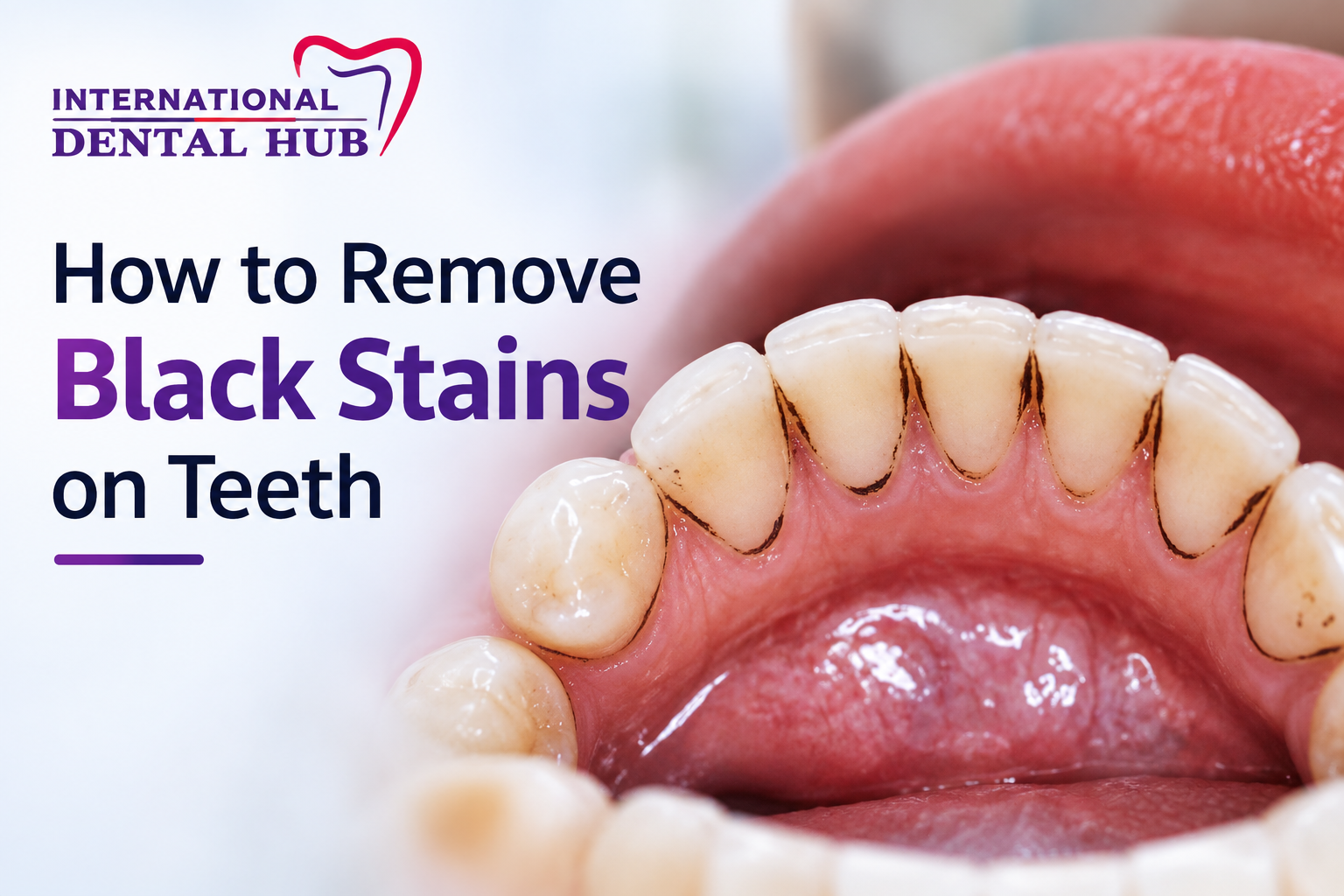
Black stains on teeth can be concerning, especially when they appear as dark lines, dots, or patches near the gumline. While some black stains come from surface deposits that can be professionally removed, dark areas on a tooth can also signal tooth decay or another underlying dental problem.
The right treatment depends on what is causing the discoloration. Professional dental cleaning may remove an external stain, while a cavity may require a dental filling or other restorative treatment.
In this guide, we explain how you can remove black stains from your teeth, what causes them, how to distinguish stains from cavities, and when to see a dentist.
What Are Black Stains on Teeth?
Black stains on teeth are dark discolorations that can appear on the outer surface of the tooth. They may look like thin black lines, small dots, or dark patches, particularly around the gumline.
One specific type is known as dental black stain or chromogenic black stain. It is considered an extrinsic form of tooth discoloration and commonly appears as a dark line or series of spots along the cervical part of the tooth near the gums.
Research study suggests that chromogenic black stains are associated with specific oral bacteria, including Actinomyces species. Iron-containing compounds can contribute to the characteristic dark color. Black stains may occur in both children and adults.
However, not every black mark on a tooth is a harmless surface stain. A black spot can also be associated with dental caries (cavities), damaged tooth structure, or heavily stained tartar.
This is why identifying the cause is important before attempting to remove it.
How to Remove Black Lines from Teeth? Five Ways
The best way to remove black lines from teeth depends on whether they are caused by surface staining, tartar, smoking, dietary habits, or tooth decay.
Professional Dental Cleaning
For many cases of external black staining, professional dental cleaning is the first-line approach.
A dentist or dental hygienist can use professional instruments, such as ultrasonic scalers, to remove plaque, calculus (tartar), and external stains that cannot be removed effectively with ordinary brushing.
Black chromogenic stains can be particularly persistent and may return after cleaning. Recent research identifies repeated professional ultrasonic cleaning as the standard approach for managing this type of stain.
If the black line is actually hardened tartar, brushing alone will not remove it. Tartar is calcified plaque and requires professional removal.
For patients in Lahore, professional teeth scaling and cleaning can help remove plaque, calculus, and many types of surface staining.
Important: Do not try to scrape black stains from your teeth with sharp objects. This can damage enamel or the gums and may cause injury.
Teeth Whitening Treatments
Teeth whitening can help improve the overall color of teeth when discoloration is primarily caused by extrinsic stains from foods, beverages, or tobacco.
Professional teeth whitening treatment in Lahore uses peroxide-based agents to lighten tooth discoloration. However, whitening is not a substitute for treating cavities or removing heavy calculus.
If a black mark is caused by decay, whitening will not repair the damaged tooth.
A dentist should therefore examine the teeth first, particularly when the discoloration is localized to one tooth or is accompanied by pain, sensitivity, a hole, or changes in the tooth’s shape.
Dental Scaling and Root Planning
If black deposits are associated with significant tartar and gum disease, your dentist may recommend more thorough periodontal cleaning.
Scaling removes plaque and calculus from the tooth surfaces. Root planning involves cleaning and smoothing contaminated root surfaces below the gumline when periodontal disease requires deeper treatment.
This is different from routine cosmetic cleaning. The appropriate procedure depends on the condition of your gums and the amount and location of calculus.
Signs that you may need a periodontal evaluation include:
- Bleeding gums
- Swollen or tender gums
- Persistent bad breath
- Receding gums
- Heavy tartar buildup
- Loose teeth
If black deposits are repeatedly forming around the gumline, a dental examination can help determine whether gum disease or another underlying condition is contributing to the problem.
Avoid Foods and Beverages That Stain
Some foods and drinks can contribute to extrinsic tooth discoloration over time.
Common examples include:
- Tea
- Coffee
- Cola and other dark-colored beverages
- Red wine
- Berries
- Soy sauce
- Other strongly pigmented foods
These substances can stain the tooth surface and can also darken existing plaque or tartar.
You do not necessarily have to eliminate these foods completely. Reducing frequent exposure and rinsing your mouth with water afterward can help reduce staining.
Good daily oral hygiene is also important. Brush twice a day with fluoride toothpaste and clean between your teeth regularly.
Quit Smoking
Smoking and other tobacco use are major contributors to tooth discoloration.
Tobacco products can cause yellow, brown, and darker surface stains. Smoking can also increase the buildup of plaque and tartar, making existing discoloration more noticeable.
Quitting tobacco is therefore beneficial not only for the appearance of your teeth but also for your overall oral and general health.
If you continue smoking, professional cleaning may remove existing surface stains, but new staining can develop again.
What Are the Causes of Black Stains on Teeth?
There is no single cause of black stains. The appearance and location of the discoloration can provide clues, but a dentist may need to examine the tooth to determine the exact cause.
Chromogenic Black Stain
Chromogenic black stain is a type of external dental discoloration associated with particular oral bacteria.
It often appears as a dark line or series of dark dots close to the gumline. Research suggests that iron-containing compounds formed through interactions involving bacterial metabolism contribute to the pigmentation.
Interestingly, studies have found that people with this type of black stain can have a lower incidence of dental caries, although this does not mean black stains protect teeth from cavities or that they should be ignored.
Tartar and Plaque
Plaque is a soft bacterial film that forms continuously on teeth. If it is not adequately removed, it can harden into tartar, also called dental calculus.
Tartar can become darker over time as it absorbs pigments from tobacco, coffee, tea, and other substances.
Unlike plaque, hardened tartar cannot be effectively removed by normal brushing.
Smoking and Tobacco
Tobacco smoke contains substances that can discolor the teeth. Smokers may develop brown or dark deposits, especially around areas where plaque and tartar accumulate.
The longer and more frequently tobacco is used, the greater the potential for visible staining.
Dark-Colored Foods and Drinks
Frequent consumption of highly pigmented foods and beverages can cause extrinsic tooth staining.
Tea and coffee are particularly common causes. When these pigments accumulate on plaque or tartar, the teeth can appear significantly darker.
Tooth Decay
A black spot is not always a stain.
Advanced tooth decay can cause a tooth to become brown, gray, or black as the tooth structure breaks down. A cavity may also appear as a hole, pit, or area of weakened enamel.
If you notice a black spot accompanied by toothache, sensitivity, food getting stuck, a visible hole, swelling, or a change in the tooth’s shape, arrange a dental examination.
If decay is diagnosed, the appropriate treatment may include a dental filling or, when the decay has reached the pulp, root canal treatment.
Certain Medications or Internal Tooth Changes
Not all tooth discoloration comes from the outside.
Some medications, dental trauma, aging, and certain medical conditions can cause changes within the tooth. For example, trauma can damage the pulp and cause a tooth to become gray or darker over time.
These intrinsic discolorations usually cannot be treated simply by removing surface stains.
Difference Between Black Stains and Cavities
Black stains and cavities can sometimes look similar, but they are not the same condition.
| Feature | Black Stain | Cavity |
| Location | Often along the gumline or tooth surface | Can occur in pits, grooves, between teeth, or other areas |
| Appearance | Dark line, dots, or surface deposit | Dark spot, hole, pit, or damaged tooth structure |
| Texture | Often a surface deposit | May involve softened or damaged tooth structure |
| Pain | Usually no pain from the stain itself | May cause sensitivity or toothache, especially as decay progresses |
| Treatment | Professional cleaning may remove it | May require filling or other restorative treatment |
| Can brushing remove it? | Some surface stains may improve, but established black stain/tartar often requires professional cleaning | No; brushing cannot repair a cavity |
Appearance alone is not always enough to make a diagnosis. A dentist may use visual examination, probing, dental X-rays, or other diagnostic methods when necessary.
This distinction is important because trying to whiten or scrub a cavity will not treat the underlying disease.
Can You Remove Black Stains at Home?
If the discoloration is caused by ordinary surface staining, improving your oral hygiene may help prevent additional staining.
However, established black stains, tartar, and calculus should not be scraped away at home.
Avoid using abrasive substances such as charcoal, acids, or other DIY whitening methods. Some unregulated or overly abrasive products can damage enamel or increase sensitivity.
A safer approach is to:
- Brush twice daily with fluoride toothpaste.
- Clean between your teeth daily.
- Drink water after stain-causing foods and beverages.
- Avoid or quit tobacco.
- Have regular dental examinations.
- Get professional cleaning when plaque, calculus, or persistent stains build up.
When Should You See a Dentist for Black Teeth?
You should arrange a dental examination if:
- A black spot appears suddenly.
- The discoloration is limited to one tooth.
- You have tooth pain or sensitivity.
- There is a visible hole or broken area.
- Your gums bleed or swell.
- You have persistent bad breath.
- The black area does not disappear after normal brushing.
- The tooth has become gray, brown, or black after an injury.
- The stain repeatedly returns after cleaning.
A dental checkup can help determine whether the discoloration is an external stain, tartar, tooth decay, or an internal change in the tooth. For patients looking to get rid of black lines or stains from teeth, International Dental Hub provides examinations and safe removal of stains in Lahore.
How to Prevent Black Stains on Teeth
Preventing black stains starts with controlling plaque and reducing common sources of discoloration.
Maintain Good Oral Hygiene
Brush your teeth twice a day for about two minutes and clean between your teeth daily. Consistent plaque control can reduce the buildup that allows stains to accumulate.
Get Professional Dental Cleanings
Regular professional cleaning can remove calculus and surface stains that cannot be removed with brushing alone.
How often you need a cleaning depends on your oral health, plaque and tartar buildup, gum condition, and individual risk factors.
Reduce Tobacco Use
Quitting smoking and other tobacco products can reduce tobacco-related staining and benefits your oral health in several other ways.
Limit Frequent Exposure to Staining Drinks
If you frequently drink tea or coffee, consider reducing the frequency and rinsing with water afterward.
Do Not Ignore New Dark Spots
A new dark spot should not automatically be assumed to be a stain. Early evaluation can help identify decay or another dental problem before it becomes more extensive.
Final Thoughts
If you are wondering how to remove black stains from teeth, the first step is to identify what is causing the discoloration.
Black lines around the gumline may be chromogenic stains or tartar and can often be managed with professional cleaning. On the other hand, a black spot caused by tooth decay requires dental treatment rather than whitening or scraping.
The safest approach is to have persistent or unexplained black stains examined by a dentist. Once the cause is identified, your dentist can recommend the appropriate treatment, whether that involves professional scaling, teeth whitening, a dental filling, periodontal treatment, or another procedure.
Medical disclaimer: This article is intended for general educational purposes and does not replace an examination, diagnosis, or treatment plan from a qualified dental professional.
FAQs
Can I remove black from my teeth?
Yes, depending on the cause. External black stains and tartar can often be reduced or removed through professional dental cleaning. However, black areas caused by tooth decay, internal discoloration, or damaged tooth structure require different treatment.
Do not try to scrape black deposits from your teeth yourself because this can injure the gums or damage the tooth surface.
Can black teeth turn white again?
Sometimes. If the dark appearance is caused by external staining, tartar, or certain types of surface discoloration, professional cleaning and, when appropriate, teeth whitening may improve the appearance.
However, a tooth that has become dark because of internal damage, trauma, severe decay, or pulp problems may require restorative or endodontic treatment rather than whitening.
What color are unhealthy teeth?
There is no single color that always means a tooth is unhealthy.
Yellowing can occur naturally with age or from surface staining. Brown or black areas may be associated with staining, tartar, or tooth decay. A gray tooth can sometimes indicate internal changes, including damage to the pulp after trauma.
The color should therefore be considered together with other signs such as pain, sensitivity, holes, swelling, bleeding, and changes in tooth structure.
Can I get rid of black stains permanently?
Black stains can often be removed professionally, but they may return.
Chromogenic black stain can be persistent and may require repeated professional cleaning. The exact recurrence pattern varies between individuals, so maintaining good oral hygiene and having regular dental examinations is important.
If the underlying cause is smoking, heavy tartar buildup, or frequent exposure to staining substances, addressing that cause can reduce the chance of recurrence.
Which Nutrient Deficiency Leads to Black Stains in Teeth?
Black stains are not generally considered a simple sign of a specific nutrient deficiency.
The most recognized form of dental black stain is associated with external pigmentation, oral bacteria, and iron-containing compounds rather than a straightforward deficiency of one nutrient.
Some research has investigated relationships between black staining and iron metabolism, but this does not mean that everyone with black stains has iron deficiency or another nutritional disorder. A person should not start iron or other supplements simply because they have black stains.
If you have other symptoms that concern you, speak with a healthcare professional who can determine whether blood tests or further evaluation are appropriate.